Showing posts with label mLearnCon. Show all posts

Friday, July 10, 2015

Augmented Reality – From Technology, Not Drugs

If you said  “augmented reality” in Chicago last weekend amidst the droves of aging Deadheads during their beloved band’s final shows, the words would likely conjure up an entirely different image than the term’s contemporary meaning.

Today, augmented reality (or “AR”) is arguably one of the hottest technology trends around.  While it has nothing to do with 1960s-inspired mind-altering substances, augmented reality promises to take us all down a long, strange trip. But an exciting one too.
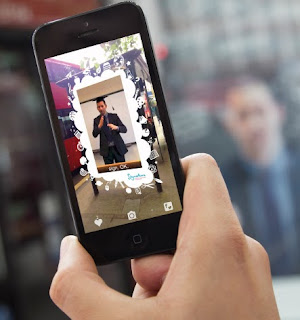
Image via Blippar
Definition: Augmented reality is a view of a real world object or environment whose elements are augmented (or supplemented) by computer generated graphics, sounds, video or other data.

AR is not new, per se. We see it on TV when we watch a football game and the network artificially places graphics on the field – like the line of scrimmage or the first down line. For years, Olympic coverage has super-imposed flags or athlete names on swimming or track lanes to give us more information to follow the action.

What’s different today, though, is the ubiquitous nature of smart phones in our world. You and over 5 billion of your closest friends now carry a mobile device that lets you launch an app, point it at an object and view of wealth of new information. Consider your reality henceforth augmented.

Meet Your Meat

Consider the following scenario:

You’re at the grocery store looking for some steaks to grill for the weekend. There are many options, cuts and brands. You want more information. You point your smart phone at the packaging label and before you more detail pops up, including when the steaks arrived at the store and who shipped them. In addition, a 3-D animation appears with audio to describe where the cow was raised and what it was fed. You can also learn about side dishes and wine pairings to serve with the steak.

AR is additional content to, ideally, enhance your view of the world. Think back to 1984 and cyborg assassin Arnold Schwarzenegger as the Terminator as he methodically sized up his opponent. In real time, data scrolls across his vision – his opponent’s height, weight, heart rate and background. Instead of appearing in your field of vision, though, AR data will appear in your mobile device.

For some great detail on AR, check out two recent compelling articles in Ars Technica by Lee Hutchinson – “Terminator-vision andthe complex questions behind ‘augmented reality’ ” and Toss your manual overboard—augmented realityaims at big industry.”

Hutchinson does a nice job of differentiating augmented reality from its decades-old twin “virtual reality,” which required helmets, special glasses and expensive set up. He describes examples from today’s world, such as apps like Sky Guide that allow us point our phone at the sky and see the constellations.

The potential for AR growth is huge.  Hutchinson describes Google's app Word Lens that performs real time translations of visual signs or printed words. Comes in handy next time you’re in a foreign country.
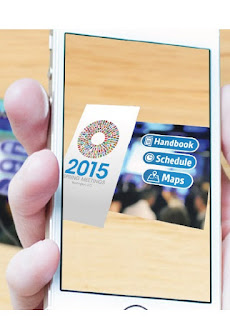
Image via Blippar
You can imagine that retailers are all over this. Beer ads will soon be jumping out from cases of Budweiser at the grocery store. Attractive, happy people will talk you through clothing options as you browse through the sweater collection at Banana Republic. You can bet augmented reality Disney characters will chat with you while you wait in line for 45 minutes before your Disney World ride.

Right Knowledge, Right Time

While the possibilities are endless, I think training has perhaps the most compelling and useful applications for augmented reality.

I work in the corporate learning field, and our constant challenge in training is to get people the specific knowledge they need for the task they are performing at the right moment they need it. This concept of  “performance support” could be greatly aided by augmented reality.

Consider, for example, instead of looking up a diagram on page 479 of a bulky Boeing jet engine manual, a mechanic points his mobile device at the engine to reveal a detailed 3-D rendering of all of the intricate parts. He can click on the parts for descriptions and review relevant instructions, ultimately improving his ability to fix the issue quickly and accurately.

The Future is Now


Qualcomm's Geoff Stead
It’s trippy stuff, but it’s not futuristic. It’s today. Last month, I attended a mobile learning conference in Austin, Texas run by the eLearning Guild. During one of the breakout sessions, Qualcomm’s Geoff Stead showcased a sample of AR featuring a Patent Wall at Qualcomm’s headquarters. By viewing the wall through your mobile phone, you have access to detailed information about each of Qualcomm’s many technology patents.

Software vendors like Blippar are already hustling to show the value of augmented reality in the training and consumer markets. Personally, I think the upside is limited only by our imaginations. I can see bus signs embedded with AR technology so with a quick look through our phone, the sign reveals the schedule, but also a map of where the next bus currently is along with the traffic situation.

Personalization with augmented reality is appealing, but there’s a line where it starts to get scary.

Imagine you launch your bank app and discover your checking account balance is low. Payday is 12 days away and your bills are all due soon. As a result, a video pops up before you to pitch a home equity loan.

As we continue to show our personal preferences through Facebook “likes,” via Twitter tweets and information we include on Linked In, how will this data from our social media profile intersect with augmented reality? What customized messages will it generate?

It’s not quite clear yet, but while after 50 years Deadheads appear to have ended their long, strange trip, I’d suggest that ours next journey is about to begin.


Saturday, June 13, 2015

The Afterglow of a Bonafide Know-It-All

We live in a world with a vast amount of knowledge, so for someone to claim to be a “know-it-all” is fairly preposterous.

Ken Jennings, however, would have a legitimate shot at this admittedly absurd title. Jennings is a Jeopardy legend, winning 74 games in a row between June and November 2004, raking in more than $3 million in prize money.  
Ken Jennings annihilating the competition

Despite this unprecedented feat, Jennings would dismiss the “know-it-all” label on two grounds: 

  1. It’s impossible to “know all” given the staggering growth of the amount of information in today’s world – doubling in quantity every 18 months or so. 
  2. It’s a worthless title because in this age of mobile phones, search engines and ubiquitous internet, knowing is less important since we can just look it up. 

The half-life of uranium? The MVP of the 1953 baseball World Series? The meaning of the Latin term “habeas corpus”? The origin of the term chickpea? It’s all there on your trusty phone.

I listened to Jennings deliver a spirited, funny and insightful keynote address this week in Austin to kick-off mLearnCon, a conference to explore the massive growth and future potential of mobile learning. During his remarks, which were highlighted by photos of his Jeopardy glory days, Jennings essentially declared that the “I Know” world is dead. For him personally, as a man heralded as arguably the best game show contestant in history, this has been a somewhat humbling reality.

“I was no longer a special little snowflake,” he told the audience of more than 1,000 learning and technology professionals assembled for the 2-½ day gathering.

Jennings’ status as special certainly started early and was by no means accidental. At the age of 10, after many months of savings, he purchased a world atlas and slept with it every night. As a kid living in South Korea, he religiously watched Jeopardy – aided greatly by the fact that it was a feature program on the one English-speaking TV channel available. In the 1980s, young Ken was wildly obsessed with the game Trivial Pursuit.

He was a self-confessed knowledge junkie. Despite his success and clear prowess, Jennings knows that computers are better at remembering information than humans. They are built to remember and do so quickly, accurately and consistently (for the most part).

Two brains and an IBM computer
He recounted his 2011 return to Jeopardy to face a menacing IBM computer named Watson. The high-powered string of servers was specifically designed to beat the pants off of mere mortal Jennings. And it did.

Computers can just do some things better than humans, and Jennings used this moment to speculate that computers will continue to render obsolete other knowledge-based jobs in our economy.  Computer-filled prescriptions, he pondered, could eliminate or lessen the need for pharmacists. Computers could do the research paralegals do, he offered. What about long-range truck drivers replaced with driverless rigs controlled by technology like Google maps?

Not only is it possible technologically, but the finances look attractive considering computers don’t get tired, need vacations or require health care benefits. They also don’t need those pesky pensions that seem to be crippling just about every state and municipality these days.

But Jennings stopped short of painting a picture of a gloomy, computer-dominated world. He suggested that in this world of abundant, accessible, ever-growing knowledge, our challenge as humans is determining what to do with it. Computers may recall, but they are much less adept at creating, making connections and being creative.

He recalled that in his epic computer smack down, Watson incorrectly answered “What is Toronto?” when Jeopardy host Alex Trebek stated, “Its largest airport is named for a World War II hero; its second largest for a World War II battle.” Ken and his other human opponent, Brad Rutter, correctly answered “Chicago”. They both could make the connection. The computer, despite its memory, circuitry and speed, could not.
Data input does not compute...

We humans have an unparalleled ability to tie information together and draw conclusions. We know, for example, that the question to answer, “Drop 1 letter from the type of creature sonic is in video games and you get this, one who monopolizes the aisle seat” is “edge-hog.”  We are creative. We can continue to put together knowledge in service of creative thinking and innovation.

Jennings also noted that we have the advantage of observation and timing. While computers are marvelous, we humans can use our brains and knowledge in ways that are impossible to predict and at moments that might prove incredibly timely.

He recalled the story of 10-year-old Tilly Smith from the UK. In December 2004, she was on the beach in Thailand with her mother, father and sister. While staring at the ocean, Tilly noticed it was behaving strangely – receding and also frothing near the shore. 

This triggered a geography lesson she’d just had on tsunamis two weeks earlier. Convinced that a tsunami was coming, a vocal Tilly proceeded to throw such a fuss, she convinced her parents and the lifeguards to clear the beach, saving nearly 100 lives before the massive tsunami soon hit.  

In his post-Jeopardy glow, Jennings has moved on to become a best-selling author, including a series of children’s books called, “Junior Genius Guides” on a range of topics. He is still an admitted knowledge junkie and is unapologetic for calling for us to adopt continual learning as a way of moving through the world.

In concluding his talk, Jennings quoted little known 18th-Century theologian and thinker Dr. Samuel Parr as saying, “It’s always better to know a thing than not to know it.”

He believes in unbridled curiosity because he knows despite what you know, there is always more to discover.  Specifically what we discover and what amazing connections we will make is entirely up to each of us.

Yours truly in an awkward face-off with Ken