Showing posts with label education. Show all posts

Sunday, August 30, 2015

The Case of the Chronically Tardy Teacher

Apparently punctuality is not an important job requirement to teach public school in New Jersey these days.  As proof of this, we have Mr. Arnold Anderson.

Over the past two years, Mr. Anderson was late to his job 111 times – 46 last school year and another 65 the prior year. Anderson, who teaches at Roosevelt Elementary School in New Brunswick, NJ, is paid a handsome $90,000 a year.

This sum, however, appears to be not enough to get him out of bed and to work in the same timely fashion you’d expect of, say, the school’s students.

Losing Track of Time

Mr. Anderson blamed his consistent and chronic tardiness on eating breakfast in the morning and losing track of time. He called his morning routine a "bad habit" but defended his recording saying he was often just a minute or two late to school, but still was prepared and made it to class on time. 

The school tried to fire Mr. Anderson. At face value, I would say this appears to be a reasonable course of action. However, an arbiter, appointed to oversee this situation between the school district and teacher’s union, ruled on August 19 not to fire Mr. Anderson. Instead, the arbiter decided to suspend him without pay until January.

The arbiter found that school officials did not provide Mr. Anderson with due process by giving him formal notice of his inefficiency and did not give him 90 days to correct the issue before seeking to terminate him.

It appears from news accounts (including this article in the UK’s Daily Mail, proving that news travels fast) that Mr. Anderson argued that the quality of his teaching outweighed his tardiness. The arbiter wasn’t buying this and criticized his claim. 

Due Process

So, three cheers for due process, I guess, right? I certainly don’t know all the facts here. Of course, any situation in which someone might lose his or her job, it’s important to get the facts right.

But can you honestly think of any job you can be late to for over 100 times in two years and NOT get shown the door? How about 50 times? Heck, how about 25?

Apparently the only job you can pull off this kind of behavior -- at least in this case -- is teaching.

Showing Up

I have worked in education for over 20 years. I have taught school at many different levels and in both school and corporate settings. There is a simple truth about teaching that I’ve observed. You need to show up.

By “show up” I mean that it’s essential to bring energy, enthusiasm and a positive mindset to teaching. If you fail to do this, students know right away. In almost every case, they check out.

Students of all ages read their teachers. They take their cues from them. A teacher who does not show up provides the students with explicit permission to not show up themselves. It’s pretty simple.

In Mr. Anderson’s case, a 15-year teaching veteran, his not “showing up” is at an entirely different level. He literally did not show up on time. Inexplicably, he can’t motivate himself to be on time to teach elementary age students. What message does that send them?

I personally know plenty of people who would love Mr. Anderson’s job and his more than ample salary. The only thing worse than Mr. Anderson’s track record, his apparent lackluster attitude and feeble excuse for his tardiness is the fact that we have a system that makes is so hard to actually do the right thing and fire someone for this kind of clearly irresponsible and idiotic behavior.


Saturday, July 25, 2015

Teaching in a World of Distractions

Teaching in an increasingly distracted world is challenging. If you’ve taught in any context lately you know what I mean – students peeking at their laptops or eying their mobile phones under the table. For that matter, step into any business meeting and you’re likely to see the same thing.

So, if multitasking is the new normal, what can we as teachers or meeting facilitators do about it?  I would offer the following two tips:

Design for Maximum Engagement

Whenever students have skin in the game, they focus.  In my experience, the best way to engage students is to give them a job to do and a time limit to get it done.

For example, quite often during training programs we place learners in simulations that replicate real life. They have time to figure out a problem, and the culminating event is a meeting where they need to meet certain goals. They might need to report on research they’ve done, provide a solution to a problem or even just work to build a business relationship.

These role plays and the simulations that surround them not only are the most popular with students, but they are the most effective ways to learn. They’re hands-on. They’re often stressful. Ideally they’re sufficiently intense. They’re real-life. Students love them.  If designed well and facilitated correctly, there’s simply no time for distractions.

Training Your Brain

In an issue of Harvard Business Review from January 2012, Paul Hammerness M.D. and Margaret Moore, CEO of Wellcoaches Corporation, address the issue of multitasking in general. They propose three ways to help your brain learn to ignore distractions and ultimately improve your focus.

Tame Your Frenzy

Hammerness and Moore say that negative emotions sap your brain’s focus while positive emotions improve it. They recommend paying close attention to your emotions during the day (for example, you can take a 2-minute emotion check at www.positivityratio.com). By cultivating positive emotions each day through exercise, meditation or sleeping well, you improve your ability to focus.

The authors also suggest adding positive discussion topics and humor – whether you’re in class or a meeting – to boost everyone’s brain function.

Apply the Brakes

Distractions are not just from mobile devices. They’re everywhere – from sounds, sights, and random thoughts of the past or about the future. Hammerness and Moore say the best way to keep focus is to use the ABC method as your brain’s brake pedal.
  •  Become Aware of your options – either stop what you’re doing and address the distraction or choose to let it go.
  •  Breathe deeply and consider your options
  • Choose thoughtfully – Do I stop or move forward?

Shift Sets

The authors say that sometimes shifting your focus to a whole new task helps. Go for a walk, climb a set of stairs, stretch out. These can all help you refocus, meanwhile your brain many times keeps cranking and new ideas often emerge when you least expect.

So, whether you’re teaching a class or running a meeting, make sure to build in breaks. Make sure there are some physical elements to help keep everyone’s brain fresh and focused.

Design and Instruction Together

To be effective, the design of a learning experience needs to work hand-in-hand with the facilitator. If the design has engaging, action-based tasks and the facilitator is vigilant in monitoring the students, asking them good questions and helping them stay on task, then the results are likely going to be exceptional.

There’s no doubt that bad learning designs make it hard for teachers to keep focus in class. But just the same, teachers who fall in love with the lecture and talk to hear the sound of their own voice make the classroom a place rife with distraction.

In these types of classrooms or meetings, by checking their phones, daydreaming or staring out the window, people are doing anything they can just to stay awake.

It’s hard to blame them, but perhaps by using the techniques above it’s possible to work together to push back and overcome distractions.


Monday, July 20, 2015

Doc Hendley's Band of Local Heroes

I counted the spigots in my home the other day and found a total of 8. Each spigot brings clean water quickly and efficiently to my family and me.

It was an uncomplicated exercise and seemingly unremarkable result. But last week I received a reminder that for many people access to clean water is often complicated and efforts to bring it to those who need it is remarkable and extremely important.

Doc in Peru, 2009
The message came to me through Doc Hendley, the founder of the non-profit aid organization Wine to Water, which is dedicated to bringing clean water to those who need it around the world. To date, the 11-year-old organization has reached over 400,000 people in 25 countries.

Doc calls these numbers “a drop in the bucket.” Sadly, it’s true. Globally, some 800 million people lack access to clean water. Another 2.5 billion people lack access to proper, improved sanitation. The results are predictable. Each year, approximately 840,000 people (about the population of San Francisco) die from water-related diseases.

Doc came up with the idea of Wine to Water in 2003 while bartending and playing music in nightclubs around Raleigh, North Carolina. He tells the story of waking up in the middle of the night with the phrase “wine to water” in his head and reaching to his bedside to scribble down his thoughts in a notebook.

At first he thought the strange epiphany would result in him writing a hit country song, but it has actually led to founding a world-changing organization. After throwing a small local fundraiser, Doc used the money to travel to Darfur, Sudan where he began installing water systems for victims of government-supported genocide. Since then he’s continued to travel and bring clean water to people desperately in need.

I met Doc in July 2011, the first year we invited him to speak at a new hire program at Deloitte. For each year since then, Doc has returned to speak at the same new hire program. Every time Doc receives a well-deserved standing ovation.

His message is about his personal journey to find meaning in his life. It’s an inspirational call for all of us to seek out what we’re passionate about in life. It’s a message about finding ways to contribute to our world in some positive way.

He chronicles some of the many places he and his teams have traveled and continue to work. He describes how they work with the local people to figure out the problem at hand and determine the best way possible to bring clean water to the community.

Despite hearing Doc’s message 9 times, each time he leaves me both moved and inspired. Doc is a
talented story-teller. He describes what it was like to be in dangerous places like Darfur and more recently Syria. In 2010, he rushed to Haiti after the earthquake. In 2013, he flew to the Philippines to help after the typhoon. Currently, Wine to Water has over 40 volunteers in Nepal helping in the wake of the earthquake that hit in April, killing more than 9,000 people and injuring over 23,000.

Doc has an uncomfortable relationship with the term “hero.” Many see his work and the efforts of his teams as heroic. CNN agreed, naming him a CNN hero in 2009. But when I had lunch with Doc last Friday in Dallas, he talked specifically how his teams are set up and how they operate. Hearing this underscored for me why they have managed to be so successful.

Paulo Freire in 1991
Doc said that unlike other aide organizations, Wine to Water goes out of their way to blend in. They don’t, for example, all wear matching  shirts with Wine to Water logos. They work closely with locals. By design, their teams are heavily made up of locals – the people who live the problem, know the land, know the language and the customs, and have a direct stake in solving the problem.

By operating this way, the local teams take on full ownership. Instead of seeing themselves as passive receivers of instructions from visitors, locals see themselves as active players – agents of change in their communities.

The inspiring and insightful Brazilian educator Paulo Freire wrote passionately about this subject. Freire wrote about how people must be “subjects” who know and act and not “objects” who are known and acted upon. Freire believed that dialogue is essential in all contexts – including education or any situation which the goal is knowledge and change. 

He believed that to alienate people from their own decision-making is oppression and preventing people from engaging in the process of inquiry equates to violence.

When I returned home to Chicago last Friday, I found my copy of Freire’s influential 1970 book, “Pedagogy of the Oppressed.” In it, I found the quote:

“One cannot expect positive results from an educational or political action program which fails to respect the particular view of the world held by the people. Such a program constitutes cultural invasion, good intentions notwithstanding.”

Me and Doc in Dallas
Doc Hendley and his team bring people together. They help people learn. They work with them to
collectively solve a very real problem by figuring out the best way to access clean water. The solution is different in each location – Honduras, Ethiopia, Nepal, Cambodia, Philippines, Dominican Republic. When locals drive the effort, they will believe in it, improve it and sustain it.

Yes, Doc and Wine to Water acts with urgency, compassion and care. They are intelligent and resourceful people. They want to create a better world. But I believe the reason they succeed is they understand they must respect the locals, their voice, their views, their cultures and their ideas.


Doc understands that creating this bond with the locals and pulling them together under the cause of clean water is what needs to happen. A humble and passionate leader, Doc may shrink from the word “hero,” but I think he’d agree that his techniques and methods have effectively created bands of local heroes around the world that are making a big difference in people’s lives.

Saturday, July 18, 2015

Stories: 3 Hairs, 2 Lessons

I heard a story this week I thought was worth passing on. Not only did it have a good message, but for teachers who often use stories in their classrooms it also had two important lessons.

First, the story. Thanks to Tod Smith at Deloitte for telling it.

A very, very old woman looks in the mirror. She’s almost completely bald except for 3 strands of gray hair. As she looks at herself, she wonders what hairstyle to wear.  Eying her three strands, she decides that a braid works best. She weaves the strands together and happily starts her day.

The next day as she looks in the mirror, two strands of hair are left. In considering her hairstyle, she decides that pigtails are best. She arranges her hair and starts her day.

The next day when she wakes and looks in the mirror she sees just one strand of hair. The decision on her hairstyle is quick: Ponytail, she says to herself, smiles and starts her day.

The next day, her final strand of hair is gone. She’s completely bald. As she looks in the mirror she grins. How much simpler her morning will be now, she says to herself, now that she won’t have to fuss over her hairstyle. She smiles and starts her day.

The moral of the story is that attitude is everything. If you approach your day with the right attitude – optimistically, with acceptance and positive energy – it makes all the difference in your life.

When I heard this story, I liked it for two reasons. First, it was well-told, well-placed and brief. Second, it characterizes the approach to learning in the classroom that I think great teachers must have.

Storytelling

Telling stories is a tremendous tool for learning. Stories are memorable. We not only remember the words of a story, but also we remember how we feel about the story. As a result, our brain gives us two ways to recall stories. As humans and learners, we are hard-wired for stories.

Stories are wonderful ways to encapsulate a key point. But to be effective, they need to not only be well-told and well-placed in a class, but they also need to be short. Hearing this story the other day took about 2 minutes, which is a great length.

Nothing kills a story more than length. If you want to be sure to lose your audience, provide a lot of unnecessary details and draw out your story. As time ticks, listeners’ minds wander. 

Be merciful. Be effective. Be brief. Get to the point, make it and move on.

Optimism, Acceptance, Positive Attitude

Hearing this story reminds me that to be effective in the classroom, teachers need to bring optimism and positive energy. I design, develop and deliver learning for a living. The teachers I want teaching my classes bring an attitude of optimism, and they set a positive tone.

This tone is infectious for the students. They want to learn. They feed off the teacher’s energy.

Great teachers take what each class gives them, like the old lady accepted her day. They approach the task of teaching ahead with a smile and positive energy, just like the old lady approached her day.

So, the next time you are a student, look for that optimism in your teacher.  If you don’t get it then provide that feedback. For teachers, the next time you teach, think about the attitude you project to the class. It is positive?


Make a deliberate decision to be positive and it will pay off.

Friday, July 10, 2015

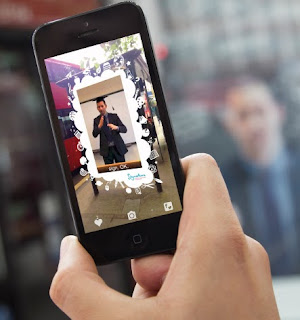
Augmented Reality – From Technology, Not Drugs

If you said  “augmented reality” in Chicago last weekend amidst the droves of aging Deadheads during their beloved band’s final shows, the words would likely conjure up an entirely different image than the term’s contemporary meaning.

Today, augmented reality (or “AR”) is arguably one of the hottest technology trends around.  While it has nothing to do with 1960s-inspired mind-altering substances, augmented reality promises to take us all down a long, strange trip. But an exciting one too.

Image via Blippar
Definition: Augmented reality is a view of a real world object or environment whose elements are augmented (or supplemented) by computer generated graphics, sounds, video or other data.

AR is not new, per se. We see it on TV when we watch a football game and the network artificially places graphics on the field – like the line of scrimmage or the first down line. For years, Olympic coverage has super-imposed flags or athlete names on swimming or track lanes to give us more information to follow the action.

What’s different today, though, is the ubiquitous nature of smart phones in our world. You and over 5 billion of your closest friends now carry a mobile device that lets you launch an app, point it at an object and view of wealth of new information. Consider your reality henceforth augmented.

Meet Your Meat

Consider the following scenario:

You’re at the grocery store looking for some steaks to grill for the weekend. There are many options, cuts and brands. You want more information. You point your smart phone at the packaging label and before you more detail pops up, including when the steaks arrived at the store and who shipped them. In addition, a 3-D animation appears with audio to describe where the cow was raised and what it was fed. You can also learn about side dishes and wine pairings to serve with the steak.

AR is additional content to, ideally, enhance your view of the world. Think back to 1984 and cyborg assassin Arnold Schwarzenegger as the Terminator as he methodically sized up his opponent. In real time, data scrolls across his vision – his opponent’s height, weight, heart rate and background. Instead of appearing in your field of vision, though, AR data will appear in your mobile device.

For some great detail on AR, check out two recent compelling articles in Ars Technica by Lee Hutchinson – “Terminator-vision andthe complex questions behind ‘augmented reality’ ” and Toss your manual overboard—augmented realityaims at big industry.”

Hutchinson does a nice job of differentiating augmented reality from its decades-old twin “virtual reality,” which required helmets, special glasses and expensive set up. He describes examples from today’s world, such as apps like Sky Guide that allow us point our phone at the sky and see the constellations.

The potential for AR growth is huge.  Hutchinson describes Google's app Word Lens that performs real time translations of visual signs or printed words. Comes in handy next time you’re in a foreign country.

Image via Blippar
You can imagine that retailers are all over this. Beer ads will soon be jumping out from cases of Budweiser at the grocery store. Attractive, happy people will talk you through clothing options as you browse through the sweater collection at Banana Republic. You can bet augmented reality Disney characters will chat with you while you wait in line for 45 minutes before your Disney World ride.

Right Knowledge, Right Time

While the possibilities are endless, I think training has perhaps the most compelling and useful applications for augmented reality.

I work in the corporate learning field, and our constant challenge in training is to get people the specific knowledge they need for the task they are performing at the right moment they need it. This concept of  “performance support” could be greatly aided by augmented reality.

Consider, for example, instead of looking up a diagram on page 479 of a bulky Boeing jet engine manual, a mechanic points his mobile device at the engine to reveal a detailed 3-D rendering of all of the intricate parts. He can click on the parts for descriptions and review relevant instructions, ultimately improving his ability to fix the issue quickly and accurately.

The Future is Now


Qualcomm's Geoff Stead
It’s trippy stuff, but it’s not futuristic. It’s today. Last month, I attended a mobile learning conference in Austin, Texas run by the eLearning Guild. During one of the breakout sessions, Qualcomm’s Geoff Stead showcased a sample of AR featuring a Patent Wall at Qualcomm’s headquarters. By viewing the wall through your mobile phone, you have access to detailed information about each of Qualcomm’s many technology patents.

Software vendors like Blippar are already hustling to show the value of augmented reality in the training and consumer markets. Personally, I think the upside is limited only by our imaginations. I can see bus signs embedded with AR technology so with a quick look through our phone, the sign reveals the schedule, but also a map of where the next bus currently is along with the traffic situation.

Personalization with augmented reality is appealing, but there’s a line where it starts to get scary.

Imagine you launch your bank app and discover your checking account balance is low. Payday is 12 days away and your bills are all due soon. As a result, a video pops up before you to pitch a home equity loan.

As we continue to show our personal preferences through Facebook “likes,” via Twitter tweets and information we include on Linked In, how will this data from our social media profile intersect with augmented reality? What customized messages will it generate?

It’s not quite clear yet, but while after 50 years Deadheads appear to have ended their long, strange trip, I’d suggest that ours next journey is about to begin.


Monday, July 6, 2015

The Exceptional Benefits of Mistakes

When England’s Laura Bassett kicked the soccer ball into her own team’s goal last week, England lost its Women’s World Cup semi-final match to Japan.

It was a mistake. She’d attempted to kick the ball away, of course, but the ball went left off her foot instead of right and snuck past England’s goalkeeper. Bassett wept. Her teammates hung their heads. Soccer fans throughout England were crushed.

Through all this sadness and disappointment, there’s something for us to learn. As an educator, I think there’s tremendous value in mistakes of all shapes and sizes. I maintain that every mistake can be viewed as a positive because it reveals a little bit of the truth.

If we’re solving a problem, a few solid mistakes lay the path to the solution. This morning I was conscious of the truth-revealing nature of mistakes as I dropped my two young daughters off for the first day of their one-week technology camp called “Adventures in Robotics.”

The Debugging Philosophy

During the camp, which is run by the California-based company ID Tech and held on the Evanston campus of Northwestern University, I’m hoping that my girls make hundreds of mistakes, perhaps even thousands, as they learn how to create computer programs to bring small robots to life.

Part of what they’ll learn is how to debug the instructions they type into a computer. If the program does not work properly, they’ll have to figure out why, fix it and try again.

Seymour Papert
No educator has spoken more persistently and eloquently about the value of mistakes in learning and adopting a “debugging philosophy” than mathematician and Massachusetts Institute of Technology professor Seymour Papert. For decades, the now 87-year-old Papert has argued that schools have given the word “mistake” a bad name. He explains this in his 1980 book “Mindstorms” (subtitled “Children, Computers and Powerful Ideas”).

“The ethic of school has rubbed off too well. What we see as a good program with a small bug, the child sees as ‘wrong,’ ‘bad,’ ‘a mistake.’ School teaches that errors are bad; the last thing one wants to do is to pore over them, dwell on them, or think about them,” Papert writes.

He continues in his book, “The child is glad to take advantage of the computer’s ability to erase it all without any trace for anyone to see. The debugging philosophy suggests an opposite attitude. Errors benefit us because they lead us to study what happened, to understand what went wrong, and, through understanding, to fix it. Experience with computer programming leads children more effectively than any other activity to ‘believe in’ debugging.”

In 1999, I had the good fortune of taking a class with Papert at MIT while I was attending the Harvard Graduate School of Education. The class had no tests, no assignments and no textbooks. Instead, led by Papert’s questions, we spent each class discussing and debating ideas and talking through how people solve problems. It was marvelous.

“Everyone learns from mistakes”

My daughters this week will have a bit more structure in class. Their teacher, whom I met this morning, goes by Dr. Beats (aka Nathan) and studied robotic engineering at Worcester Polytechnic Institute. He will be introducing the class to LEGO Mindstorms’ robotic platform to teach them how to use motors, sensors and computer programs to create robots.
ID Tech's Dr. Beats

LEGO Mindstorms was developed through a partnership between the MIT Media Lab and LEGO. The origins go back to Papert. In the 1960s, Papert co-developed a programming language called LOGO aimed at improving the way children think and solve problems. LOGO allowed a small turtle robot to draw line graphics based on simple computer commands. It encouraged exploration and experimentation by both the students and teachers. To Papert, this is key.

“Some people who observe the children’s growing tolerance for their ‘errors’ attribute the change of attitude to the LOGO teachers who are matter-of-fact and uncritical in the presence of programs the child sees as ‘wrong,’ ” Papert writes.  “I think that there is something more fundamental going on. In the LOGO environment, children learn that the teacher too is a learner, and that everyone learns from mistakes.”

A Glimpse of the Future

In addition to making mistakes and learning from them, I hope this week my girls have fun and develop confidence in their ability to solve problems. As a parent, though, I must confess an ulterior motive. If this experience happens to ignite a spark that leads either or both of them to a future interest in computer science, that will be just fine.

I am keenly aware that as my girls reach college in 10 years and then begin their job search, computer science jobs will be abundant. In fact, over the next 10 years, there will be 1 million more computer jobs than students to fill them. Moreover, of the 6 industries expected to grow the most by 2020 (just 5 years away), technology pays the highest at an average of $78,730 a year. (See an infographic created by the Computer Science Zone.)

Credit: computersciencezone.org
The reality is that our schools are not doing enough to prepare students for these jobs. Today, 9 of 10 high schools in the U.S. don’t offer computer science classes. In addition, girls continue to not choose computer science as a major or as a career as well. Of all the computer science graduates today, only 12% are women.

So, while Laura Bassett’s mistake was on a big stage in front of millions of viewers, perhaps it also offers a glimmer of the truth. Maybe, as some soccer analysts have suggested, she was out of position slightly, allowing her opponent to get past her at a critical moment. She tried to adjust, made an error and no doubt has learned a valuable (and difficult) lesson.

During this week and well beyond, I can only hope the same for my daughters.


Friday, July 3, 2015

Great Teachers: We Need You

While most of us have teachers from our past who have inspired and shaped us, the sad reality is we’ve all had some real duds as well.

Remember that class that you dreaded attending? You showed up just as the bell rang and watched the clock minute after painful minute until the bell rang again releasing you from the misery of that class?

It’s quite possible you’ve had more duds in your educational career than superstar teachers. Both the highs and the lows tend to stand out for me.

In May, I wrote a post called “What Makes a Great Teacher?”and described how inspiring my 7th grade social studies teacher, Mrs. Stephan, was for me. Ironically, that same year, I had a science teacher that I’ll always remember for all the wrong reasons.

I’ll call him Mr. Mumbles to hide his actual identify all these years later.  But here was a teacher who could not have been more ineffective as an educator. I recall nothing about science from that impressionable year in my life, but I do recall many things about him and how he ran his class.

Me in 7th grade
First, he mumbled. It was painful. Our sizable class was spread over numerous lab stations – complete with sinks and gas jets for Bunsen burners. Depending on where you sat, his mumbles were inaudible. If you could hear him, it made little difference. His lectures were dry, boring and rambling. Let’s just say National Geographic film days that took up most of the period were a welcome relief.

Naturally, when Mr. Mumbles spoke, the class disengaged. Usually a small subset of students moved to the front with their pens and pads of paper to hear him talk and take notes, while others did whatever they wanted.

Personally, I joined both groups depending on my mood, but as the year wore on, I found myself drawing pictures in my notebook or staring at a girl with braces and long ponytail whom I fantasized about talking to, but could never muster up the courage to actually do so.

In that same May 15 blog, I revealed a number of brilliant replies to a question I posted to a Linked In discussion group. Specifically I asked, “I am researching great classroom facilitation. What qualities do you think make teachers great?”

I’d like to revisit this topic of “Great Teachers” because I received so many wonderful replies to that question from all over the world. These particular 5 insightful trainers, educators and learning consultants are from Canada and the United Kingdom.

Here is what each had to say.

Tuula Lindholm, a training and learning solution specialist from Toronto, Canada, provided the following qualities of great teachers:
  • Encouraging story-telling, dialoguing to allow issues to surface fully


  • Listening for cues and clues about learning needs that may not be so obvious

  • Responding and having others respond to/comment on to encourage consensus building and/or to draw out multiple points of view (not just the popular ones...)

Ability to admit own limitations, lack of knowledge, when necessary


Fran Traynor, lead trainer and learning designer at New College in Manchester in the United Kingdom, wrote:
“In my experience, great teachers are assistants and guides to people learning. They help people to identify what they need to know/do and then they assist people in getting enthusiastic about setting and travelling towards goals, reaching, assessing and celebrating their achievements both stage by stage and holistically."

Jane Smith Parsons, a curriculum development consultant in Newfoundland and Labrador, Canada, noted that great teaching is an art. She wrote:
“Great facilitation is knowing how to deliver the technical aspects in a way that comes across relaxed, fun, and engaging….We must always remember that great facilitation brings out the best in others... It is not our experience but theirs... So we must understand the multitude of ways others become engaged and offer up the opportunities through a sequential and necessary process that heightens each individual's learning experience.”

Paul Cook is an on demand learning specialist living in London, England. He wrote:
“What the learner does is more important than what he teacher does.”
Kevin Fitzsimons, an education consultant from Hull, United Kingdom, was equally concise stating the quality he feels is critical for a great teacher. He wrote:
“A sense of humour, which helps you to keep a sense of proportion.”
So, to sum it up, I am taking away this list:
  • Skilled storyteller
  • Patient listener
  • Discussion leader
  • Classroom guide
  • Artist
  • Persistently student-focused
  • Good sense of humor

I think that’s a darn good list. Thank you Tuula, Fran, Jane, Paul and Kevin. Your insights are appreciated and exceptionally well-stated.

My 7th grade yearbook
As for my paradoxical 7th grade year at Springman Junior High School in Glenview, Illinois, I
survived. Perhaps this heaven and hell experience was training for future blissful and then disappointing moments that happened in close proximity to each other. Sadly, mediocrity in the classroom is more common than it should be.

For teachers in schools, in companies and in any location where the goal is to learn, the opportunity to be great is so awesome and critically important. Don’t shrink from it, but embrace it. We need you.


Friday, May 15, 2015

What Makes a Great Teacher?

 In 2013, Ayad Akhtar won the Pulitzer Prize for Drama for his play “Disgraced.” When he was asked during an interview about his play and his other writing, Akhtar, a 44-year-old New Yorker, said, “I’d had a wonderful high school teacher who made me want to be a writer. Everything I do is an homage to her.”

When I heard him say this, a series of images in passed through my head about what his teacher must have been like, how she ran her class, what she must have felt like when she learned her student won the Pulitzer Prize. Through these images, though, I found myself staring at the face of my 7th grade teacher at Springman Junior High School – Mrs. Stephan.

She was a kind, matronly woman who kept wadded up tissues in the sleeve of her sweater. Her reddish brown hair sat like a beehive on the top of her head. She had a pleasant, understated smile, unusually warm hands and she smelled like the fragrant soap balls my grandparents kept in a seashell dish in their master bedroom.
Ayad Akhtar - (Photo by Nina Subin)

I thought of how through her quiet confidence in me she managed to fill me with more energy and enthusiasm than I thought possible. Granted, I was only 12, my voice cracked with startling regularity. I had not quite discovered deodorant, had persistent acne and was stumbling awkwardly into my early teenage years.

This started me thinking about great teachers. Truthfully, I actually think of this subject often. But let’s just say this comment from Akhtar and my mental tumble back in time to Mrs. Stephan's classroom prompted me again to ask myself the question, “What makes a great teacher?”

Like you, I have my opinions, but I was curious what others thought. To get answers, I posted this question to a few discussion groups on Linked In. It’s a great place, Linked In – full of thoughtful, well-spoken people, I’ve found. I asked the educators, “What qualities make a great teacher?”

I received many replies. Here are a few that I thought hit the mark.

  • Professional trainer Jason Sturges of Alexandria, Virginia wrote that great teachers “focus on the participant needs (versus) just getting through the content.”
  •  It’s a simple thing, but he’s totally right. How many instructors have you had that seem bent on plowing through the content come hell or high water? I have had more than a few. Great teachers focus on what the students need first. 

  • Ann Adler, a learning designer and facilitator from Cumbria, England wrote several things that I loved. She noted that great teachers “understand what it means to be a learner and how to develop learning capability in those they teach”. She also stated that great teachers “draw out, rather than pour in, learning.” 
  • I agree completely. You can’t forget what it is to learn and expect to be a great teacher. We can all tell when teachers have lost the desire to learn. They become jaded, lecture and frankly dial it in. Old-school lecturers attempt to generically dump information into our head – with alarming inefficiency.  Great teachers, in contrast, draw out – they draw us out, draw out our energy, our curiosity, our capabilities. 

  • Dr. Martin Carnap, a longtime educator and coach in Costa Rica, wrote that you can best define great teachers by focusing on their students. Do the students take initiative during class? Do they make decisions? Do they feel the importance of what they’re doing? Do they look for alternative points of view and modify ideas, focus and strategies? If so, he wrote, you have a great teacher. 
  • Well said, Martin. All I can add is that to great teachers, it’s truly all about the students and less about the teachers. Their own ego fades into the background. I wish more of the teachers I had (and continue to have) subscribed to this idea, don’t you?

  • Kathy Miller, head of the English Department at Coulsdon Sixth Form College in the UK had many great thoughts, but the two I liked the best were: (1) Be open to and ask for feedback from your students and (2) Love the students- care about them- there are many ways to demonstrate this.
  • What can beat this? Teachers, first off, should never stop learning, so feedback is a must no matter how many years they’ve been in the classroom.  In my view, someone who is not open to feedback likely has a distorted sense of his or her own effectiveness or is afraid to hear what he or she already expects or knows.
  • Second – we all realize when someone cares about us and when that person does not.  If a teacher cares, you know it right away and you’re very likely to care more about learning. It’s like my friend Tammy Berman told me recently, “Kids won’t care what you know until they know that you care.” I would only add that in addition to kids, we can include adults as well.   
So, was Ayad Akhtar’s teacher all of these things? My bet, quite honestly, is yes. Did she focus on his needs? Did she act as a learner, draw out instead of pour in? Was her ego in check and did she love and care for him as a student?


I would say absolutely. If she hadn’t, would he still have been a writer? Would he have won the Pulitzer Prize? It’s impossible to say, but it’s a question worth considering as we think about the power teachers have and the influence they can have in people’s lives and their importance to the broader success of our society.

Thursday, May 7, 2015

The Perils of "Live" Learning


Recently I was staring at my computer screen waiting for a live interview to begin. It was 1 p.m. and the interview was with Salman Khan, the founder of Khan Academy.

I was intrigued about this interview for two reasons. The first reason:  I’m a big fan. Khan, the 38-year-old founder of Khan Academy, is a pioneer and many regard him as a leading thinker in education. I read his 2012 book, “The One World School House” and found it inspiring. I was interested in what he was going to say during this one-hour interview.

The second reason I was intrigued was that the interview was live. I found this, well, ironic. Dating back to 2003, Khan has recorded over 5,000 videos and created exercises on a wide range of topics that are all delivered via YouTube for people to consume wherever and whenever they want. Time and place are not a factor – which is a big part of what’s made his approach to learning so revolutionary and effective. So, the idea of a “live interview” with Khan seemed not only odd, but also kind of unnecessary.

 KZO Innovation's "live" interview with Sal Khan
1:08 p.m. Still nothing. I’m wolfing down a plate of mini-carrots and hummus because I skipped lunch to fit in a conference call. Now I’m staring at a screen of old fashion TV color bars and the words on the screen read, “offline.” That’s it.

I grumble, still amused by the irony at hand. I instant message a colleague of mine in Texas to make sure I don’t have the wrong link. He quickly confirms he’s staring at nothing as well. We’re both waiting and we aren't alone. The Twitter feed embedded into this interview launch screen is popping with Tweets – questions like, “What’s happening?” “Is there a problem?” “Does anyone hear anything?” All very logical questions.

Biting into a mini carrot, I wonder how they heck they make these carrots so small. Do they pull them out of the dirt early or do they cut them up and shave them down? I honestly don’t know. I also wonder what it must be like at K-ZO Innovations, the Reston, Virginia company running this live – yet to be aired – event.  They must be totally freaking out.  Almost 10 minutes in and it’s complete crickets.   Finally, K-ZO, a technology company that delivers video via the web, sends an e-mail stating that they are having technical difficulties and that the event will begin  “shortly.”

I'm annoyed, but decide to stick it out. After all, it’s Sal Khan – king of the recorded lesson, the guy who has over 15 million students watch his videos and take over 4 million lessons every single day. It’s a compelling model not simply because of the convenience of learning at your own time, but also your level and your own pace.

I think of how teachers in live classrooms struggle to meet the needs to students on the high ability end and the low ability end at the same time. With 25-30 kids, it’s hard to reach them all. But through his videos, lessons, feedback and tracking, Khan's system does this really well.

There is also no stigma for students of asking the teacher to repeat something because they don’t "get it." It’s a video. They can rewind and watch again. They take the lesson again until they get it right. They spend as much time as they want and then move onto another lesson that follows or select a different one that intrigues them.

What they do on Khan Academy is done on their own time, outside of school – and in their own language.  Khan’s approach has been proven to boost student performance – both when it's used in a school setting and outside of school.

Oh, one additional thing. It's all free.

1:10 p.m. Scraping the last hummus from my plate with a nub of baby carrot, I chuckle at the Tweet by learning luminary Allison Rossett as she replies, “What exactly do they mean by ‘Soon?”  We all wait until finally, K-ZO Innovations lets us all know they are pulling the plug on “live” and will send out a recording in a few hours.

It was as it should be. Much more convenient. Whatever happened was a colossal collapse and quite embarrassing for a company that delivers video via the web. To K-ZO's credit, though, they were humble, contrite and quickly churned out a white paper detailing the event, calling it, "When Live Goes Wrong." I will say, I really like their approach using video for learning, by the way. Very smart design. These guys appear to have something compelling.

As I was watching the recorded interview of Khan, of course I was impressed with him. Video is powerful. It's can work on the job and in schools. Hearing him talk, my mind kept going back to a recent meeting I attended at my daughters’ elementary school. The district’s superintendent, on the job less than a year, had just finished talking to about 30 parents in the school’s library about the painful $2.2 million in cuts they were planning for next year.

Salary costs are rising along with transportation costs and other operating expenses. Meanwhile, revenues are not keeping pace. Unless something changes, the deficit in our relatively small 17-school district will climb to nearly $9 million in 4 years. This was not happy news to me, a parent of a 9 and 6-year-old.

A parent seated behind me asked the superintendent: “How does the district plan to use technology?” The superintendent, who is a bright, caring guy doing a very good job thus far,  provided a “we’re open to ideas…” answer. I thought of Khan, his 5,000 videos, lessons and quizzes and scribbled in my notebook, “Send link to recorded "live" interview to superintendent.”

Clearly a future in which our education system more fully embraces technology needs to come sooner rather than later. Thoughtful, integrated, well-executed technology has stopped being a “nice to have” in schools. Universities have gotten the message – at least some have. Businesses have known this for a long time.


Even at the elementary level, a blended-learning approach, combining technology with live classroom instruction – needs to start being simply how children today learn.